
In this article
- What are telomeres?
- Why do telomeres matter?
- What can we do to protect our telomeres?
- Avoid smoking and air pollution
- Reduce stress
- Eat a healthy diet and maintain a healthy weight
- Exercise regularly
- Key points to consider
What are telomeres?
Telomeres1 are part of our genome (our genetic make-up). They are located at the end of the chromosomes2 in our cells.
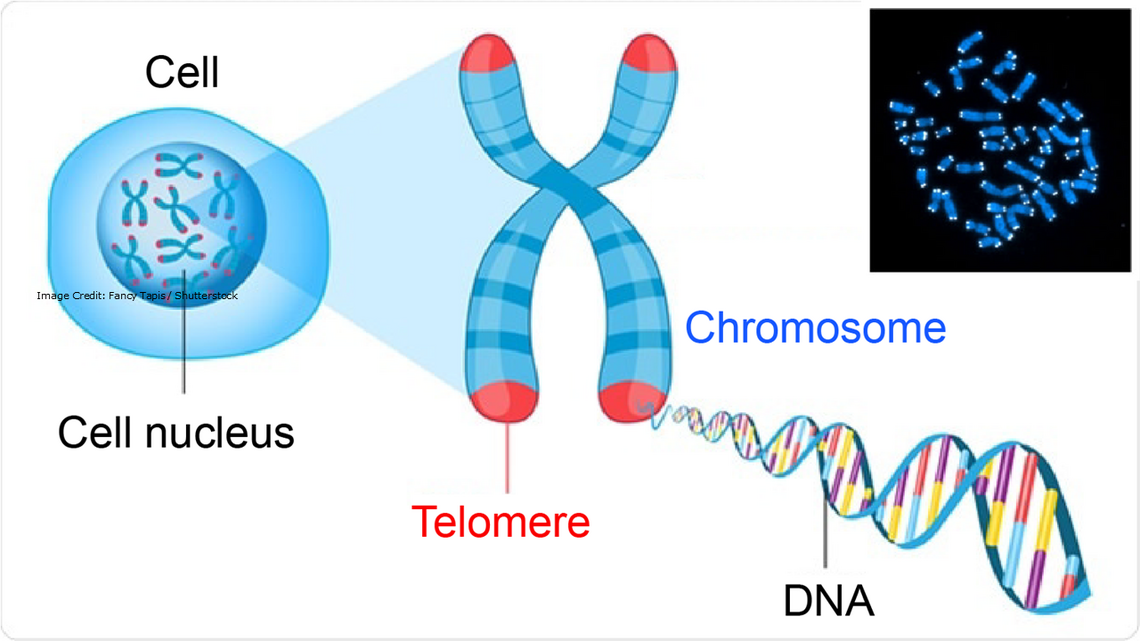
Image Credit: Fancy Tapis / Shutterstock
Telomeres form a cap, like the plastic tip on shoelaces, which protects our DNA. The length of telomeres is shortened by age, by many age-related illnesses and by cancer. Their length depends on enzyme telomerase, which repairs them and maintains their length during successive rounds of cell division.
Why do telomeres matter?
Telomeres protect the two ends of our chromosomes, and therefore they play a vital role in protecting our genetic make-up3. However, every time a cell divides, part of the telomere is chopped off from the chromosome’s end, and the telomere gets shorter. When a telomere becomes too short, it can no longer protect our genome, the cell can no longer divide, and it becomes inactive or “senescent” and dies.
Telomere-shortening is a risk factor for numerous diseases and may be a general biomarker of ageing.
There seems to be a clear association between the length of our telomeres and our health and longevity.
The link between shorter telomeres, increased illness and shorter life in people was first reported in a study published in The Lancet in 20034. In that study, adults over 60 were grouped according to the length of their telomeres. Those with shorter telomeres were more likely to die earlier, mainly due to heart disease and infectious illnesses. In contrast, people with longer telomeres at the start of the study lived, on average, around five years longer.
Following studies reinforced this connection. A 2007 twin study showed that among older twins, the sibling with shorter telomeres was roughly three times more likely to die first5. Then in 2014, a systematic review of published research involving some 36,000 participants found that some studies suggest telomeres are longer in women than men6.
More recently, a 2025 review of previous studies found that people with shorter telomeres are more likely to develop a wide range of age-related diseases, including heart diseases, diabetes, kidney diseases, and conditions such as Alzheimer’s7. The authors suggested that when telomeres become too short, cells can't divide or repair themselves effectively, which may contribute to tissue damage and disease as we age.
However, it is not clear whether shorter telomeres directly cause disease, or merely act as a marker of biological ageing - a reflection of how much stress and damage our cells have accumulated over time.
While many studies link shorter telomeres to ageing and disease, not all findings are consistent, and it remains unclear whether shorter telomeres directly cause health problems or are simply markers of vulnerability to illness and an early death8. One critical review suggested that focusing on telomere length alone is overly simplistic, as it can fluctuate, varies widely between individuals, and often fails to reliably predict ageing outcomes9. Whichever the case, it seems to be in our interests to protect the length of our telomeres for as long as possible.
Individual telomere-testing is still in its infancy and isn’t yet available on the NHS for general testing. So, for the moment, the focus needs to be on what we can do to protect our telomeres, based on the research published.
What can we do to protect our telomeres?
The good news is that some research suggests that a healthy lifestyle seems to help to protect our telomeres and support healthy ageing7. Our lifestyle choices are important:
- Avoid smoking and air pollution
- Reduce stress
- Eat a healthy diet and maintain a healthy weight
- Exercise regularly
Avoid smoking and air pollution
Early research suggested a link between smoking, obesity, and shorter telomeres. For example, a 2005 study in The Lancet found that the white blood cells of obese women had shorter telomeres than those of lean women of the same age, estimating this could reduce life expectancy by nearly nine years10. This study also reported that women who smoked more tended to have shorter telomeres10.
However, in contrast, a 2014 study found that lifestyle factors such as smoking, increased body weight, and physical inactivity were not consistently associated with telomere length, highlighting the complexity of the relationship11.
More recent evidence helps clarify the picture. A 2020 systematic review of studies on prenatal smoking concluded that maternal smoking during pregnancy is mostly linked to shorter telomeres in babies, suggesting early-life exposures can have lasting cellular effects. While not all studies agree, the majority support the idea that prenatal smoking may negatively influence long-term health at the cellular level12.
Similarly, air pollution has emerged as another factor influencing telomeres. A 2023 study of nearly 472,000 UK Biobank participants found that higher exposure to pollutants, particularly sulphur dioxide and nitrogen oxides, was associated with shorter telomeres - a sign of faster cellular ageing. The effect was more pronounced in women, younger adults, and people with lower income or higher body weight, underscoring how environmental and social factors may interact with cellular health13.
Taken together, these findings reinforce that avoiding smoking and minimising exposure to air pollution are likely important for protecting telomere length and promoting healthy ageing, even if individual studies sometimes report inconsistent results.
Reduce stress
Stress is increasingly recognised as a factor that may contribute to shorter telomeres. Some research suggests that experiences even before birth, such as cumulative psychological stress during pregnancy, can influence a child’s telomere length.
A 2023 analysis of pooled data found that higher maternal stress during pregnancy was linked to shorter telomeres in newborns, suggesting prenatal stress may influence an infant’s cellular ageing. The researchers combined results from several studies and found a small effect. This adds to the growing evidence that what a baby experiences in the womb (including the mother’s stress levels) can shape their health in later life14.
However, a 2020 study of 1,405 newborns reported no significant association between maternal stress, anxiety, sleep, body mass index (BMI), depression, or smoking and newborn telomere length. The authors suggested that differences in methodology may explain why the effect was not detected, highlighting the need for standardisation of methods and cautious interpretation15.
For general psychological stress, a 2024 systematic review of adults aged from middle to older age found that higher levels of psychological stress were associated with shorter telomeres, especially among women or individuals experiencing major stressors16. Long-term, chronic stress may have a bigger impact over time, and researchers suggest that future studies should follow people over many years to better understand how stress affects our cells16.
Taken together, managing stress through mindfulness, relaxation, social support, or other strategies may help protect telomeres and support healthier ageing.
Eat a healthy diet and maintain a healthy weight
Research has suggested that the type of foods that are present in our diet may affect the length of our telomeres.
Recent evidence highlights the role of specific fats: higher intake of omega-3 fatty acids (found in oily fish) is linked to longer telomeres, while diets with a high ratio of omega-6 to omega-3 fats may be associated with shorter telomeres17. This suggests that more omega-3 (fatty fish, flaxseed, soy and walnuts) and less omega-6 (vegetable oils) in our diet may be helpful for maintaining telomere length. As we identify elsewhere on the Age Watch website, we need some omega-6 in our diets (but not too much), and it needs to be balanced by omega-3.
A major European study of more than 2,000 women also found that excessive maternal weight gain during pregnancy was associated with shorter telomeres in children, highlighting the importance of a healthy weight for both mothers and offspring18.
More recent research supports and expands on these findings. A 2022 systematic review and pooled analysis found that higher adherence to a Mediterranean diet, which is rich in fruit, vegetables, whole grains, nuts, seeds, and healthy fats, was associated with longer telomeres19. Similarly, a 2025 study emphasised that plant-based diets rich in antioxidants and anti-inflammatory nutrients, combined with sufficient omega-3 intake, can help protect telomere length and promote healthier ageing20.
These findings suggest that focusing on a plant-based, nutrient-rich diet, maintaining a healthy weight, and balancing omega-3 and omega-6 intake may be effective strategies for supporting cellular health and slowing aspects of biological ageing.
Exercise regularly
Research suggests that a sedentary lifestyle is associated with shorter telomere length. However, regular physical activity may help protect telomeres and slow cellular ageing. A 2019 review of 11 studies involving over 19,000 participants found that people who were more physically active had longer telomeres than inactive individuals. More vigorous activity was linked to slightly greater telomere length, while gender did not appear to influence results21.
Endurance exercises, like running, swimming, cycling, or brisk walking, can boost telomerase, the enzyme that repairs and maintains telomeres. For example, a German study showed that a single 45-minute jog increased telomerase activity for several hours, whereas traditional weight-machine circuits had little effect. Resistance training remains important, however, for maintaining muscle and bone strength as we age22.
More recent research continues to support these findings. A 2025 meta-analysis of randomised controlled trials confirmed that aerobic exercise and high-intensity interval training (HIIT) can help preserve telomere length, particularly after at least 16 weeks of regular activity. Resistance training showed smaller, less consistent effects23. Another 2024 review noted that while evidence quality is mixed, HIIT appears most promising for telomere protection24. Additionally, a 2022 study found that a lifetime of brisk walking could be associated with biological ageing 16 years “younger” by midlife, based on telomere measurements25.
Overall, these studies suggest that engaging in regular aerobic or interval-based exercise may help keep cells healthier, slow the ageing process, and complement other lifestyle strategies for protecting telomeres.
Key points to consider
- Telomeres are the body’s natural protectors of our DNA, and keeping them healthy is key to slowing biological ageing.
- Shorter telomeres are linked to higher disease risk and a shorter lifespan, but while we can’t control ageing or our genes, we can influence many lifestyle factors.
- Simple choices such as avoiding smoking, staying active, maintaining a healthy weight, eating a fibre- and omega-3-rich diet, getting enough sleep, and managing stress can help protect our telomeres and, in turn, our health.
- Most research suggests that these everyday habits don’t just feel good. They also help keep our cells younger for longer, giving us a better chance to enjoy a longer, healthier life.
Read these Age Watch articles next
- Fitness: Exercise and live longer
- Fitness: Keeping fit – why bother?
- Fitness: Can fitness compensate if you’re overweight?
- Living longer: Look after your body
- Living longer: Adding years to your life, and life to years
- Age and gender: Women and smoking
- Tackling obesity: Preventing obesity
Reviewed and updated by Raymon Hunte, February 2026.
References
- What is a telomere? | Definition of telomeres. (n.d.). Retrieved 10 October 2025, from https://www.yourgenome.org/theme/what-is-a-telomere/
- Chromosome - humans, body, used, process, life, chemical, form, cells, basic. (n.d.). Retrieved 10 October 2025, from http://www.scienceclarified.com/Ca-Ch/Chromosome.html
- Telomere. (n.d.). Retrieved 10 October 2025, from https://www.genome.gov/genetics-glossary/Telomere
- Cawthon, R. M., Smith, K.R., O’Brien, E., et al. Association between telomere length in blood and mortality in people aged 60 years or older. Lancet, 2003. https://doi.org/10.1016/S0140-6736(03)12384-7
- Bakaysa, S. L., Mucci, L.A., Slagboom, P.E., et al. Telomere length predicts survival independent of genetic influences. Aging Cell, 2007. https://doi.org/10.1111/j.1474-9726.2007.00340.x
- Gardner, M., Bann: D., Wiley, L., et al. Gender and telomere length: Systematic review and meta-analysis. Exp Gerontol, 2014. https://doi.org/10.1016/j.exger.2013.12.004
- Huang, X., Huang, L., Lu, J. et al. The relationship between telomere length and aging-related diseases. Clin Exp Med, 2025. https://doi.org/10.1007/s10238-025-01608-z
- Vaiserman A & Krasnienkov D. Telomere length as a marker of biological age: state-of-the-art, open issues, and future perspectives. Front Genet, 2020. https://doi.org/10.3389/fgene.2020.630186
- Chilton, W., O’Brien, B., & Charchar, F. Telomeres, aging and exercise: Guilty by association? Int J Mol Sci, 2017. https://doi.org/10.3390/ijms18122573
- Valdes, A., Andrew, T., Gardner, J.P., et al. Obesity, cigarette smoking, and telomere length in women. Lancet, 2005. https://doi.org/10.1016/S0140-6736(05)66630-5
- Weischer, M., Bojesen S.E. & Nordestgaard, B.G. Telomere shortening unrelated to smoking, body weight, physical activity, and alcohol intake: 4,576 general population individuals with repeat measurements 10 years apart. PLoS Genet, 2014. https://doi.org/10.1371/journal.pgen.1004191
- Wei, H., Zhang, C., & Silveyra, P. The relationships between prenatal smoking exposure and telomere lengths in fetuses, infants, and children: A systematic literature review. J Addict Nurs, 2020. https://doi.org/10.1097/JAN.0000000000000364
- Wu, Y., Gasevic, D., Wen, B., et al. Association between air pollution and telomere length: A study of 471,808 UK Biobank participants. Innov Med, 2023. https://doi.org/10.59717/j.xinn-med.2023.100017
- Moshfeghinia, R., Torabi, A., Mostafavi, S., et al. Maternal psychological stress during pregnancy and newborn telomere length: a systematic review and meta-analysis. BMC Psychiatry, 2023. https://doi.org/10.1186/s12888-023-05387-3
- Ämmälä, A.J., Vitikainen, E.I.K., Hovatta, I., et al. Maternal stress or sleep during pregnancy are not reflected on telomere length of newborns. Sci Rep, 2020. https://doi.org/10.1038/s41598-020-71000-2
- Souza‐Talarico, J.N., Chesak, S., Elizalde., N., et al. Exploring the interplay of psychological and biological components of stress response and telomere length in the transition from middle age to late adulthood: A systematic review. Stress Health, 2024. https://doi.org/10.1002/smi.3389
- Crous-Bou, M., Lázaro, I., Nadal-Zaragoza, N., et al. Fatty acids and telomere length. Curr Opin Clin Nutr Metab Care, 2025. https://doi.org/10.1097/MCO.0000000000001093
- Developmental Origins of Healthy and Unhealthy Ageing: The Role of Maternal Obesity | FP7. (n.d.). CORDIS | European Commission. Retrieved 10 October 2025, from https://cordis.europa.eu/project/id/278603/reporting
- Canudas, S., Becerra-Tomás, N., Hernández-Alonso, P., et al. Mediterranean diet and telomere length: A systematic review and meta-analysis. Adv Nutr, 2020. https://doi.org/10.1093/advances/nmaa079
- Polom, J., & Boccardi, V. Employing nutrition to delay aging: A plant-based telomere-friendly dietary revolution. Nutrients, 2025. https://doi.org/10.3390/nu17122004
- Lin, X., Zhou, J., & Dong, B. Effect of different levels of exercise on telomere length: A systematic review and meta-analysis. J Rehabil Med, 2019. https://doi.org/10.2340/16501977-2560
- Werner, C. M., Hecksteden, A., Morsch, A., et al. Differential effects of endurance, interval, and resistance training on telomerase activity and telomere length in a randomized, controlled study. Eur Heart J, 2019. https://doi.org/10.1093/eurheartj/ehy585
- Sun, L., Zhang, T., Luo, L., et al. Exercise delays aging: Evidence from telomeres and telomerase—a systematic review and meta-analysis of randomized controlled trials. Front Physiol, 2025. https://doi.org/10.3389/fphys.2025.1627292
- Luis, J., Sánchez-Rodríguez, J. L., Varela-Rodríguez, S., et al. Effects of physical exercise on telomere length in healthy adults: Systematic review, meta-analysis, and meta-regression. JMIR Public Health Surveill, 2024. https://doi.org/10.2196/46019
- Dempsey, P. C., Musicha, C., Rowlands, A. V., et al. Investigation of a UK Biobank cohort reveals causal associations of self-reported walking pace with telomere length. Commun Biol, 2022. https://doi.org/10.1038/s42003-022-03323-x